Tuesday, 10 July 2012

No private practice for MOH non-UAE doctors

Expatriate physicians working full-time in MOH government facilities and part-time in the private sector in Dubai will no longer be allowed
Dubai: Expatriate physicians who work full-time at any Ministry of Health (MOH) government facility will no longer be allowed to work part-time in the private sector in Dubai beginning October 1, a senior Dubai Health Authority (DHA) official told Gulf News yesterday.
“The [affected people] are only the non-UAE physicians who are working full-time in MOH and part-time in the private sector in Dubai,” Dr. Ramadan Ebrahim, director of DHA Health Regulation Department, said.
A DHA circular released on July 4 said that all DHA part-time licenses for non-local physicians will be cancelled by October 1, 2012. Non-complying professionals and facilities will be penalised. The decision came following a directive from the MOH in April.
Dr. Ebrahim said around 300 physicians will be affected by the decision. However, if these doctors still want to practise in the private sector of Dubai, they have an option.
“We will automatically cancel their licenses by 1st of October, unless they resign [from MOH]. If they resign there, then we will continue their license,” Dr. Ibrahim said.
Dr. Ebrahim clarified that no other healthcare professionals will be affected by the decision.Doctors in Dubai said they do not see any problem with the implementation of the new rule by October. Dr Sreekumar Sreedharan, an Indian specialist physician in Dubai, told Gulf News that this decision should not have any serious effect in the health sector.
“It should not be a problem at all for the health sector. If there is going to be an effect, it will be for the doctors who are in the public sector as they may lose some extra income and benefits. They usually work in the private sector outside their working hours, so this is not a very serious issue,” Dr. Sreedharan said.
“The idea of getting public sector doctors to work in the public sector alone is a good step because this will help curb any unethical practices that may happen from the practice. This is in fact being done in other countries as well,” Dr. Suresh Menon, medical director and chief internal medicine specialist at Lifeline Hospital, told Gulf News. “Practising in the two sectors gives you a dual mentality and will confuse your outlook because private and public practice are two different things. This DHA step is actually well-advised.”

Need License for Fishing in UAE

Dh500 fine for indiscriminate fishing in Dubai


Dubai: 
Indiscriminate fishing in Dubai can draw a fine from Dh100 to Dh500, a senior Dubai Municipality official has said.
The civic body issues fishing permits to people but there have been incidences of people going in for fishing around the Creek, Mamzar Park and open beach areas which has led the civic body to control the activity. The Environment Emergency office of the municipality has launched a new campaign in this regard.
“Indiscriminate fishing, combing all small creatures living by seaside is punishable and may draw imposition of fines up to Dh500,” said Khalid Suletin, Head of Environment Emergency Office at Dubai Municipality
The municipality is taking a serious view of people who fish in coastal areas without permission. The officials of the department will be patrolling the coastal areas to check illegal fishing.
Emphasising that people must keep in mind the impact of their actions of the environment, Suletin said: “People go to these areas and hunt for crabs, lobsters, whatever they may get, which is a big threat to marine stock.”
The Dubai Municipality issues two types of licences for recreational fishing — line and hook, either in coastline or with leisure boat.
Obtaining a licence is a must for individuals who want to go for fishing. This is done in accordance with the Federal Law No. 23 of 1999 on the Exploitation, Protection and Development of Aquatic Resources in the UAE and the Federal Law No. 24 of 1999 for the Protection and Development of Environment.
Suletin said the civic body grants licences only if the applicants adhere to certain requirements. “We are issuing fishing permits to people. But it is never meant to spoil our marine wealth. Permits are given with certain conditions, ” he continued.

Monday, 9 July 2012

Places to work for Women in UAE

Women are allowed to practice the following professions from 10:00 pm
to 7:00 am:
- Working in hotels, restaurants, inns, cafes, buffets, theatres, movie
theatres, halls of music and singing and other similar shops.
- Working in transporting persons and goods by interior water routes or
by air including the offices of tourism and airlines and in airports.
- Procedures of the annual stocktaking, setting up the budget and
clearance, closing accounts and getting always ready for selling in low
prices and opening seasons. In this case, it is conditioned that the
days of work, in which women are allowed to work at night, mustn’t
exceed more than fifteen days in a year except if the special labour
department gives license for longer periods.
- If the job aims preventing a dangerous accident to happen or
restoring what is resulted from it, or avoiding an inevitable loss of
some materials which may become spoiled.
- If the job aims facing an extra ordinary pressure of work. In the last
two cases it is conditioned informing the special department of labour
inspection of the statement of the extraordinary case within 24 hours
and the requires period for the job so as to get a written approval from
it.
- Working in the commercial shops in the month of Ramadan and the
three days which precede the Greater Bairam “Eid Al Adha”.
- Working in hospitals, sanitariums, doctors’ clinics and other treatment
centres.

Sharjah rents drop 6% on new tenancy rules

Apartment rents in Sharjah dropped six per cent on average and in some areas fell as much as 21 per cent in the second-quarter because of increasing vacancy rates in some areas and the introduction of stricter tenancy rules, Asteco Property Management said in a report on Sunday.
"New regulations regarding shared accommodation have been introduced with tenants in Sharjah required to disclose their salaries and confirm that people living together are family members only," said Elaine Jones, chief executive officer ofAsteco .
"Subsequently, we have seen tenants who previously shared accommodation, move independently to more affordable smaller units, prompting a decline in rental rates."
Tenants in Sharjah must now provide detailed documents for all people staying in their home under strict new laws introduced in May.
Rents for apartments along the Mina Road and in Al Yarmouk declined 21 per cent and 12 per cent, respectively while property along the commuter belt in Al Khan and Al Nahdah fell just one per cent compared to the previous quarter.
Apartments in the Corniche area saw a marginal gain of two per cent, quarter-on-quarter, Astecosaid in its quarterly report on property prices in the Northern Emirates.
The cost of renting a villa in the emirate remained steady with a three-bedroom property in Al Khan (Mamzar), Shargan and Al Quz costing around Dh70-77,500 annually.
Neighbouring Ajman also saw a slight downturn in Q2 with decreases in apartment rental rates for studio and one-bedroom units, particularly in the Al Naimia area and new buildings on the Corniche. While there was no change in rental rates along major -- thoroughfares such as Shaikh Khalifa Road, Al Quds and Al Nakheel in the second quarter, both Shaikh Hamid Road and Corniche Road rents fell by an average of six per cent.
"Ongoing issues with utility connections, especially those in new buildings, is still a major issue for prospective tenants who are placing generator-powered buildings firmly at the bottom of their housing wish lists," said Jones.
The cost of renting an apartment in Umm Al Quwain and Fujairah remained steady while Ras Al Khaimah started to stabilise toward the end of the second quarter, the report said.
Transaction volume in the Sharjah office market followed first quarter trends with limited movement and rents remained static across the major commercial hubs, with the exception of Al Wahdah, which dropped by five per cent to Dh484 per square metre.
In contrast, Dubai's real estate market is showing robust signs of resilience with both rents and prices of quality properties recording an upturn after remaining in the doldrums for years.
"Quality residential developments in Dubai bounced back during the second quarter after a stable first quarter, with average rent increases of six per cent for apartments and nine per cent for villas," said Asteco in a separate report. Sales prices recorded double-digit increases in three developments, with rises of six-eight per cent elsewhere, it said.
"After three years of declining rates and limited sales activity, the real estate market is on the way to recovery, with established quality communities showing increases in values and higher transaction volumes," said Elaine Jones, chief executive at Asteco . Towards the end of first half in 2012, rentals in established quality communities achieved average increases of six per cent.
Apartments in Dubai Marina and Downtown Dubai were the most sought after witnessing a 10 per cent increase, with a two-bedroom apartment fetching between Dh90,000 and Dh120,000 per annum. "Tenants are relocating in search of value-for-money, one- and two-bedroom apartments as well as three- and four-bedroom villas are the preferred unit types. In terms of rates, quality well-managed developments, will continue to set the pace," said Jone

Sunday, 8 July 2012

World's best performing markets

To say it was a tough first half for the global economy would be an understatement. It was practically torrid as markets vacillated to market-moving news which were, for the most part, grim.
On more than a few occasions, the European Union bloc threatened to implode with a series of nerve-wracking elections and new faces that seemed determined to undo the fragile negotiations weaved by their predecessors to keep the fragile entity together.

Elsewhere, the United States fared poorly with uninspiring job growth and a deadlocked political environment. Worse, even the stalwart BRIC -Brazil, Russia, India and China - saw growth sputter and their economic environments deteriorate.

Even the relatively insulated safe havens in the Middle East could not escape the doom. Initially, the regional markets made a valiant start to shrug of global economic weakness and did well till the first quarter, before losing their nerve by the second quarter and joining the global economic gloom.

IMF chief Christine Lagarde summed up the global economic mood: "This crisis does not recognize borders. This crisis is knocking at all our doors. For make no mistake: This is a global crisis," she told an audience in Tokyo.

The IMF's updated assessment of the world economy - to be released eight days from now - will highlight that the global growth outlook will be somewhat less that was being anticipated just three months ago. And even that lower projection will depend on the right policy actions being taken.

"A combination of the persistence of the euro area debt crisis alongside the lagged impact of last year's monetary tightening in emerging markets has caused global business confidence to turn lower," says Julian Callow, an analyst at Barclays Capital in a report. 

"In turn, this constitutes downside risks to our global GDP projections for the second half. Already this week, our U.S. GDP projection has been trimmed for 2012 to 2.2%, compared with 2.4% previously, and to 2.1% from 2.5% for 2013), based mainly upon more cautious behaviour now expected of the U.S. business sector, resulting from financial market volatility and concerns about Europe."

In light of these grim developments, the stock markets that orbited around their domestic issues fared much better than those that were connected to the global economy.

"The start of 2012 saw a major comeback by the bulls," noted NBK Capital. "Markets across the globe began to rally, and financial woes seemed to be a thing of the past. However, toward the second quarter of 2012, global issues began to resurface, pushing several markets down.

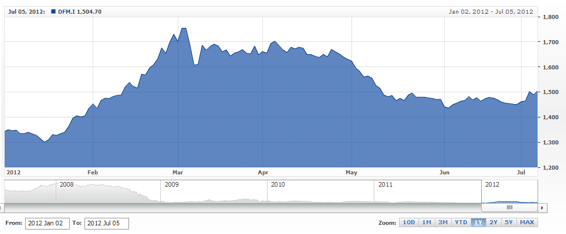
DUBAI TOP PERFORMING GULF MARKETDubai was the second best performing market in the region in the first half, rising as much as 25% earlier in the year, but saw much the gains wiped out by the second quarter.

Some of its key sectors such as real estate, tourism and retail fared well, while Dubai Inc. companies made steady progress in working through their debt issues. But the market was side-swept by global fears and lost most of their gains.


Source: Zawya.com

Other Gulf markets fared poorly despite a great start. Like Dubai, the Saudi Tadwaul peaked at 23.57% by April, but steadily fell back to post a 4.9% growth by the end of the first half, Zawya data shows. The market lost much of its steam primarily due to global economic fears and oil prices falling from their triple-digit perch in the second quarter.

The banking sector led the march with cement, real estate and industrial sectors putting in a strong performance and offsetting petrochemicals' poor showing.

RAK: Room for growth

With the economy continuing to expand, retailers in Ras Al Khaimah (RAK) are hoping for a period of sustained growth, benefitting from rising local incomes and an increasing number of tourists, but they are also mindful of the competition from neighbouring emirates.
There has been steady growth in RAK's retail sector, with new malls and high-street outlets opening on a regular basis over the past few years. This growth has been supported by a solid domestic economy, which the government forecasts will expand by around 8% this year, the same figure recorded in 2011.
Despite this growth, the market has not yet reached its saturation point. According to some estimates, the gross leaseable area (GLA) for RAK's retail sector is set to hit almost 200,000 sq metres by 2015, more than double the figure in 2010. This would give the emirate a per-capita GLA of 0.736 sq metres, well below Dubai and less than half the projected figure for Abu Dhabi for 2015, which is expected to have almost 1.7 sq metres of retail space per person. By comparison, the US has a per-capita GLA of around 1 sq metre, while in the EU the total is just 0.231.
RAK Mall, the latest entry into the retail sector, was developed by the Abu Dhabi-based Lulu International Group. The $110m mall, which opened in April 2012, has a total area of 93,000 sq metres and is home to a Lulu hypermarket, a food court, an entertainment zone including an ice rink, and local and foreign brand-name retailers.
In mid-March, RAK Properties, the state-backed developer and operator, announced it had appointed real estate consultancy Colliers International to manage the retail development and leasing operations for both its Julphar Towers office and residential complex and the Mina Al Arab coastal residential and resort project.
Among the tasks assigned to Colliers will be attracting major international and regional retail brands. Jewellery, food and beverage, fast-moving consumer goods, fashion and consumer electronics have all been identified as areas that will be targeted.
While the local sector is performing well, it faces a number of challenges going forward. The sheer size and variety on offer in Dubai and Abu Dhabi is perhaps the most significant factor. While many brand-name outlets have a presence in RAK, others do not, opting instead to focus on these larger emirates. This is in part due to the fact that many who live in RAK actually work in Dubai; commuting is straightforward and those who spend their days in Dubai also shop there.
While at least some residents may continue to do their shopping elsewhere, RAK's retail sector will be one of the beneficiaries of an expected surge in tourism over the next few years. State agencies estimate that tourism arrivals will hit 1.2m by 2013, a figure that is expected to climb after the $1bn theme park, sports and real estate project, to be developed in partnership with Spanish football club Real Madrid, opens at the beginning of 2015.

Return of investors?

Regional markets are showing steady improvement. After a few years in the wilderness when Gulf markets were wrapped up in dreary gloom, they appear to be showing signs of investor participation once again.

After the global financial market crash of 2008, many local and regional investors were wiped out. Faced with a falling real estate sector, and consistently declining market indices, retail investors fled the scene and many remain on the sidelines to this day.

The greatest fear among remaining market participants was that those investors may never return. Many brokerages closed shop as investors' lost their appetite due to falling stocks and the vicious circle of lack of interest and declining economic sentiment pulled markets further than their fair value.

The lack of investor confidence also put the brakes on initial public offerings (IPOs), which are now seen a rare occurrence. 

Many companies pulled or delayed their public listing plans, citing tepid market conditions and feared a lack of investor appetite. As such, markets failed to gain the breadth and depth needed for a healthy flow of investments and choices and encouraging the investment pools to grow.

But new data on volumes in the Gulf markets suggest investors may be tentatively dipping their toes back into the market.


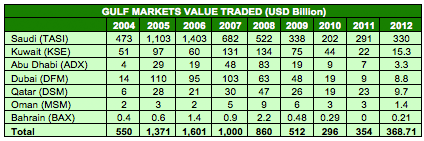
The first half of the year saw USD368-billion trading collectively in Gulf markets. That has already exceeded trading for 2010 and 2011. Given the current trajectory, Gulf markets are set to exceed the USD512-billion worth of trade posted in 2009.

"Average daily value traded increased in most markets across the GCC in 1H2012," notes NBK Capital in a report to clients. "The Tadawul Exchange showed an outstanding pick up in trading, as the average daily value traded increased to USD2.7-billion in 1H2012, more than double the average daily value traded in 2011, marking the highest average daily traded since the 2008 credit crisis."

The Dubai Financial Market and Kuwait Stock Exchange also showed an increase in average daily trading activity between 2011 and IH2012, increasing 127% and 18%, respectively. However, the Qatar Exchange and the ADX were the clear laggards, as the average daily value traded declined in each market by 11% and 8%, respectively.

But there is a long way to go for most markets to re-scale the peaks reached previously.

At the height of the Gulf market buzz, the Saudi Tadawul saw trades worth USD1.4 trillion in 2006.

Dubai FM had its best year in 2005, posting a USD110-billion worth of trades, at a when Gulf markets could do no wrong.

Meanwhile, Kuwait's best year was in 2008 with USD134-billion, primarily as investors were deleveraging and fleeing the market, especially from the financial services sector.

Of course, the Gulf economies have made massive improvements over the past year with greater growth and government spending lifting the prospects of many key companies.

This has been most visible in Saudi Arabia where USD131-billion investment package has unleashed a wave of contracts in the country.

Regional markets have also benefited from greater prominence due to Qatar and UAE's potential elevation to emerging market status.

Gulf markets also appear to fare better than their emerging market counterparts on a number of criteria. Given their growth trajectory, their valuations seem far more attractive than BRIC states and G7 nations.

GCC's price-to-earnings (PEG) growth ratio is close to 1.0x, compared to the G7's 5.0x and BRIC's 1.4x, according to data.

"Qatar seems to be the most attractive among its GCC peers as it trades at the lowest PE multiple in the region of 8.6x with one of the highest GDP growth rate expectations for 2012," according to NBK Capital. This puts the country's PEG ratio at 0.7x compared to the weighted regional average of 1.1x."

Regional markets also offer greater dividend prospects for investors. The weighted average dividend yield in the GCC stands at 3.5% compared to 2.5% for BRIC markets. The UAE and Qatar are even more attractive, offering dividend yield of 4.5% each.

MSCI's recent suggestions that it could include Saudi Arabia as an emerging market at some point may also pique the interests of many international and regional investors.

However, none of these developments take away from the fact that the markets need greater depth of companies. With the exception of Saudi, Gulf markets are dominated by banks, real estate and telecom companies, with many of the sectors such as energy, power, tourism, retail and services under-represented in regional indices.

Hopefully, the rise in trading volumes would also encourage companies to list on the exchanges buoyed by resurging investor interest.

Zawya data shows six Gulf companies raised USD1.1-billion to list on regional exchanges in the first half of the year, which is at least three times greater than the value raised during the same period last year. But it is a shadow of the glory days of the first half of 2007 when 42 companies raised more than USD5-billion in a frenzy of activity.

It may take a long time before such volumes once again return to the regional markets. But rising trading trends could unleash the pent-up desire for regional companies to list on the markets, especially as the global financial services sector takes a beating. And that could attract new waves of investment to the market and, consequently, fresh batches of investors.